|
Issue 9,
Volume 8, 23 July 301 AP The Story behind the news. |

|
Business
How Nuclear power could come back Auranj Mfg issue profit warning Politics Utania's new government Lasanne's election results Nystonia's election results Savana's election results Utani B'yan's election results Law Hijacked! The story inside. Will this old man get any justice? International COVER: Is Rovens falling apart "Zartanian go home!" And they are. Sport Football: The agony of defeat - Luka takes a tumble! Football: Savaj sack their coach. |
|
Subscribe to Zeitgeist
Subscriber queries |
|
What IS a Zeitgeist?
Jerman for "Spirit of the Age". In this case it is to mean the "spirit" of the Utanian people, the magazine reporting the people's thoughts behind the press-releases and reported news. Want an article published? Would you like an article published by Zeitgeist Magazine? Please send the text of the article for evaluation, OR send us an email describing the issue/story you would like published to the email Editor@jaggedblue.com. |
|
©Zeitgeist Magazine, 301 AP.
Email: Editor@jaggedblue.com <TECH> ©Mike Ham, 2001. All rights reserved. No reproduction without, at least, tacit approval. ;-) |
A strong swing to the Conservative Party, and the state's gain of one seat, turned into a three seat gain to the Conservative Party, and two seat loss to the Peoples Party. Yet, despite this conservative victory, overall the popular vote swing against the
 government is zero. We look inside the changes and winners and losers in Utania's most
affluent state.
government is zero. We look inside the changes and winners and losers in Utania's most
affluent state.
Lasanne state is Utania's financial and manufacturing centre, and is the most affluent in the country. The population is one-third non-Utani, its capital city was the central link to the island of Guwimith, and the central entry point for thousand of non-Utani immigrants to the region. It is also the most conservative region in all of Utania. The Utani and non-Utani alike have grown up, in the semi-autonomous era, with successive Conservative or Democrat governments, who have ruled for 24 of the past 34 years of semi-autonomy, who have pressed for economic self-development. The virtual motto for the attitude of the state has long been the words of Governor Durning (Con; 273-82) who said that "Industriousness and self-investment are the keys to success".
Therefore, it is little surprise that the state returns 33 right-wing MPs of 48 for the state, and that 17 of those are Conservatives, and 7 more are Democrats. 23.5% of the population voted Conservative -- up from 20.4% ten months ago -- at this election, of the 66% of people who voted right-wing*.
Popular vote
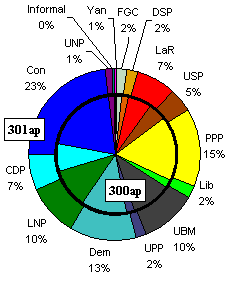
7.63 million voters cast a valid vote in this year's federal election in the state of Lasanne, the second-largest state in the country, and this is down from 8.1 million voters last year -- down 5.5% -- because of the reallocation of voters to their resident electorates in other states.
Lasanne is also the primary stronghold of the Conservative Party in Utania: 56.3% of all votes cast for the party were cast in Lasanne state (the state has only 31% of all registered voters). This year, the strength of the Conservative Party was up 8.7% compared to ten months ago, collecting 1,795,518 votes this year, or 23.5% of the state's votes. To reflect this increase, they earned an additional three seats representation, effectively winning the state's additional seat in Parliament -- due to the census -- and stealing two from the Peoples Party.
However, despite the significant increase in Conservative votes, the leftist parties* lost little overall support despite the loss of seats. Having said that, the two main government parties, the Peoples and Utani Saedaj parties lost 2.7% of the state vote, or 12.3% of their own vote. And as the leftist vote didn't really change, this means the voter support for other leftist parties rose: Republican Party, up one-seventh of their vote; support for the Free Green Collective rose an additional one-third, as did the Democratic Socialists.
Several electorates expanded in size, that is, increased the number of MPs representing the electorate, while the electorate of Twizel, in the less populated west of the state, was merged into the Ujam electorate. The Peoples Party had an MP in each of Ujam and Twizel electorates, but did not win two MPs in the merged electorate.
In Charleston electorate, the Peoples Party popular support changed from 13.3% down to 10.2% -- losing 6,000 votes in an electorate that increased by 156,300 voters -- leaving Peoples Party MP John Hampton defeated by a mere 894 votes to the Liberal Nationalist candidate, Geoffrey Roberts.
Down 6.7% this year, fortunately, were informal votes
The Result for Parliament
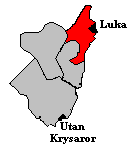
With a strong swing to the Conservative and from the Peoples Party -- being 3.1% and 2.4% respectively -- the result was going to be a strong win for the Conservatives. Last year, they won a second MP in only three electorates: Dansvelt, Charleston and Hamilton, all electorates with strong rural agricultural with expanding light-industrial sectors. This year they added Lidcombe -- a coastal, high-revenue agriculture electorate -- and the central Luka electorate, where a large number of financial sector workers, -- stockbrokers, bankers, and other "high finance" sector, highly skilled workers -- are living.
It is also worth noting that these countryside urban electorates, which some consider the new "powerhouse" of the Lasanne economy, would also have been the primary beneficiaries of the additional power stations that were proposed by Governor Hope, but denied by President Okarvits. While it has not been happening yet, these areas are likely to feel the effect of a power generation shortage, with poor power quality and enforced power outages, or "brown outs". In all four electorates, and some others like them, the President's Peoples Party fared poorly, losing support.
Burovian MP Rachel Von Meinser lost her urban Dansvelt seat as the electorate shrank from five seats to just three, Liberal Nationalist William Bonwick lost his Hamilton seat to a second Conservative MP for that electorate after a surge of 10.1% of the electoral vote to that party, and The Democrats also gained a seat from the Burovians in the merged electorate of Gyum'th, Liberal Nationalists, too.
| Date | Yan | DSP | Rep | USP | PPP | Lib | UBM | UPP | Dem | LNP | CDP | Con | Total |
301ap |
|||||||||||||
|
IN
OUT Rachel Von Meinser (Bur), talented female Burovian MP with a great deal of political savvy and skill. She was one of the key supporters for the Okarvits government. Her presence in Parliament will be most sorely missed. She lost her semi-urban Dansvelt seat due to redistribution of seats and electorates. William Bonwick (LNP), one of the Liberal Nationalist moderates and former engineer, he was committed to protecting and investing in Utanian businesses rather than other more dubious nationalist causes. Geoffrey Lendain (LNP) was also quite a moderate JUST SCRAPES HOME Michael West (Dem); former governor of the state (Dem; 291-4), West scraped home over former (and ironically now once again!) Deputy Speaker of the Parliament, Burovian Delmore Scott (Bur), made an astute move from | |||||||||||||
Presidential race
So, what would have happened if this had been a Presidential race, or a run-off?
Well, for a start, for Lasanne state it is reasonably certain that the race would be between the eventual Conservative candidate and the President, represented by the Peoples, Utani Saedaj and Republican Parties. These parties earned respectively 10, 2 and 2 seats, but their combined candidate would be expected to do better than simply win the combined number of seats. In Utania's unique electoral system, synergy truly reigns: a candidate representing multiple parties will do better than the combined winnings of three separate candidates.
It is therefore fairly certain that the Conservative candidate and President Okarvits, representing three parties will face eachother in the run-off, winning the most and second-most seats in the Presidential election. The risk, for the Conservatives, will be if the President wins more than 50% of the popular vote in the first election -- then there is no run-off.
In Lasanne, the combined popular vote for the President's parties only amounts to only 26.5% of the state's voters. For the combined Conservative-Cruistian Democrats, the share of the vote is 30.5%.
What to do with a Û2 billion windfall
* Voting Right-wing means voting for any of the following parties: Conservative, Democrat, Liberal Nationalist, Burovian, Utani Progressive, Cruistian-Democrat, or Nationalist. To vote Left-wing means to have voted for any other party, including Peoples, Utani Saedaj, Republican, Liberal, Yannist, Democratic-Socialist or Free Green Collective.
Stock Exchange:
 Stocks continue to stagnate - when will the Govt. release cash controls? |