|
Issue 24,
Volume 9, 4 November 302 AP The Story behind the news. |
|
Business
Belson Rail: the consequences Could Langley be good for business? Politics The Battle begins Okarvits and non-Utani farmers Kemp, causing trouble on the sideline Final week of campaigning in Utani-Byan election Law Venter steel's redress Would an ID card really work? International Cimera falls apart Castronovia under threat Listonians thumb their noses the world Sport Football: Richmond's last real chance? |
|
Subscribe to Zeitgeist
Subscriber queries |
|
What IS a Zeitgeist?
Jerman for "Spirit of the Age". In this case it is to mean the "spirit" of the Utanian people, the magazine reporting the people's thoughts behind the press-releases and reported news. Want an article published? Would you like an article published by Zeitgeist Magazine? Please send the text of the article for evaluation, OR send us an email describing the issue/story you would like published to the email Editor@jaggedblue.com. Article authors It is the policy of this magazine not to identify the authors of any Zeitgeist articles. It was conceived in the early days of this magazine, by our founder, Mr van der Hamm, when authors were being threatened by Guwimithian Authorities for their anti-Imperialist columns. Our founder endured jail time in Imperial prisons for his "insolence". Now, the policy is to demonstrate that this is a magazine, not a collection of authors. |
|
© Zeitgeist Magazine, 302 AP.
Email: Editor@jaggedblue.com <TECH> ©Mike Ham, 2002. All rights reserved. No reproduction without, at least, tacit approval. ;-) |
|
Castronovian people rally to their own defence
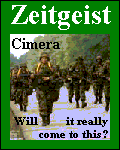
With the revolutionary "Republican" government of Cimera stating its desire to "reunite" the country with the rebellious communist enclave of Castronovia, the people of that rebel region are preparing for war. Our correspondent gives an insight. They are farmers, tailors, doctors, machine workers and students -- oh, so many students -- and they are filling the roads, jumping into trucks and cars that pass them by, all bound for one destination: the "front". It is a rag-tag army of ill-equipped and little-trained reservists and regular soldiers of the communist state of Castronovia, yet one concern unites them: defence of their homeland. The trucks and jeeps of the rag-tag army of this little communist enclave are too few, and too busy ferrying the regular soldiers and ammunition to the front line to be bothered with carting the irregulars to the front. So, they walk. And if a truck is passing by, or a car, they will pile in and on the vehicle and travel as far as it can take them. Castronovia is only a small country, 1.5 million people, but it has an army of some 45,000, plus over 100,000 reservists. Yet, their training has been, to date, minimal, and their equipment is whatever they can scrounge, or is surplus in Patakia. No tanks or armoured vehicles of any sort, very little artillery, a few hundred mortars.  But, should it come to a fight, we will be there, dying in defence of the people

The student In speaking to Illisya Reban, a 21-year old student from the capital, Rahbar, I learn that most students also signed themselves up as reservists. He is wearing jeans, sturdy black boots and a long and thick coat and carries his father's hunting rifle over his shoulder with a box full of ammunition. So poorly equipped, why would he bother? "To defend the people, brother," he tells me incredulously. "This Peoples' nation has given us freedom, jobs for those that want them, a better education than we would ever have received under the Cimerans... She is worth defending." Worth dying for? "Well, no one likes to think that they will be the next man to die on the battlefield," he admits. "I would prefer to think that the size and devotion of this people to our defence scares to imperialists from their thoughts of war, and that they turn tail and run." His friend, Matoyl, a factory worker, interjects: "But, should it come to a fight," he pauses meaningfully, "we will be there, carrying the flag of our people, dying in defence of the people, the nation that we have forged, the liberty that we have taken for ourselves." Illisya nods approvingly. Beside which, he tells me, he is hoping to pick up a better rifle at the frontline, if necessary, one from a wounded soldier. "And perhaps some more camouflaging clothes" he says with a chuckle acutely aware that his bright blue jeans stand out. The Farmer After about a mile walking along the main highway between Rahbar and the frontline to the north, we are lucky enough to be picked up by an empty farm truck.
Each one of these boys, is my son. My son lives in a thousand men such as these.
He says he's been driving back and forth to near the frontline all morning, picking up the reservists and soldiers and ferrying them to the front. "Seeing them devote themselves so wholeheartedly to the defence of our nation," he says, choking back tears, "well, I had to do my part, do what I could to help them." He tells me that his student son was a "freedom fighter" in the revolution, but was killed in the "defence" of Haliso, the coastal city that is now a Cimeran enclave within the communist state. "Feshpar died to create this country, dies at the hands of the foreign imperialists," he says, scarcely hiding his rage at the wider world for "interfering" in Hismorcan affairs. "They want to crush us again, bring us under their boots again, so they can pillage this country and its youth again." "Never!" he says, slamming his fist on the steering wheel. "My son died a hero, a martyr defending his people. And so, I will pick each one up as they march valiantly to the frontline, as they defend us again. Each one of these boys," he says, pointing to the back of the truck, "is my son. My son lives in a thousand men such as these. "That is why I drive." The Soldier We travel for a good sixty kilometres before Moran stops and lets the men out. We have reached the outer rim of the front. Suspicious looking enough -- I carry no rifle -- I decide not to chance going through the checkpoint. Moran lets the men and women off here, while he picks up refugees fleeing the frontline. Expanding before my eyes, after the barb-wire checkpoint, is a great hill with hundreds of young men and women climbing it, trucks ferrying back and forth people and boxes of supplies. It is here that I strike up conversation with a young man in uniform, 26-year old Tubruv Rarb, a regular soldier taking a cigarette break. While initially suspicious of me, he is soon opening up. "I was a machinist in a town just outside Rahbar," he explains, "But when the revolution came, I was one of the first to down-tools and sign up. The pay is better in the army, now, much better than a machinist, though that wage has improved, too."
Communism has given us a life we could only have as part of the upper class. I'll die to protect that.
So, will he see the front line? He's hoping so. "The soldiers that fought in the revolution were the lucky ones", he explains. "They fought for our freedom, they helped create this utopian state. I'm just hoping to be able to say that I fought to defend her from the second onslaught of the foreigners." For Tubruv, the war is ideological, good socialism versus bad capitalism. He says his experiences working in the factories taught him this. "It is not only dirty work, but dangerous, and the factory owners didn't care if you died. They paid the compensation -- one month's pay for an eye, two for a hand, four for a leg -- then went and grabbed another sucker off the unemployment line. "Now, the workers ARE the factory." He explains that under the communists, the managers only had one vote in how the factory was run, whereas the workers were many. This meant better working conditions, better safety, better pay, now. "Communism has given us a life we could only have as part of the upper class," he says. "I'll die to protect that." One cannot help but feel that too few of these men have been to war, and for too many, who did not see action in the bloody revolution, this forthcoming battle they regard as their greatest adventure. Riflan Blanc © 302, Zeitgeist Magazine in association with Hismorcan Independent Reporting (HIR). |
|
Related stories:
Is it really civil war for Cimera? Castronovia rallies to her own defence Christiana's Naval threats Belson employee missing Listonians thumb their noses to the world Recent Editions: President Okarvits leads in latest poll Governor Hope is Con-CDP candidate The President's policy gamble Utani B'yan state poll |
Stock Exchange:
 The only hope for capital markets in Utania: Hope! |