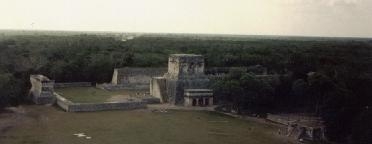
Utani "Foot-ball"
Our Utani forebears called the game Upomæta, meaning, literally, "foot
sport". Uniquely, it was played by all levels of society, though it had originated
amongst the rulers for entertainment.
 Playing with a leather ball with the air or water-filled bladder of usually a cow
inside, the players, usually three each side, would use only their feet and legs
to propel the ball through a small stone ring on a wall.
Playing with a leather ball with the air or water-filled bladder of usually a cow
inside, the players, usually three each side, would use only their feet and legs
to propel the ball through a small stone ring on a wall.
It was a popular enough game, though did not reach the levels of organisational
sophistication of the modern game of football. Still, it provided the base on which
football, when introduced, would sweep the Utani nation.
After the plague, the game was one of the first things restored, with
competitions between tribes and villages reinstated. However, weak and initially
unable to defend themselves, the Utani Empire was brought under the control of the
Guwimithians, who, in acts of merciless culture extermination, banned the game
from the Dependencies as "unsophisticated and borish". Upomæta Arenas were
progressively destroyed by Guwimithian cannonfire from about 130ap.
Of course, this just forced the sport underground, with the highlands of
the Savaj becoming the centre of the game. Yet, with hundreds of treacherous
kilometres to travel, people were unwilling to go to watch the game. They waited
impatiently for a "legal" game to take its place.
|
Modern Football
When the Ingallish came to Utania, they brought with them football, the same game
invented in the public school system in Christiana in the 150s, and codified in
171ap. Establishing teams and leagues amongst themselves, the Ingallish immigrants
also found willing participants amongst both other immigrant peoples and the Utani,
who recalled their own banned Upomæta game, and found they had football
skills easily adapted.
The game was popular amongst the oppressed Utani people who found it to be a
way they could mercilessly defeat their "enemies" and oppressors without significant
lives being lost. Blood, however, was often shed at matches, with play sometimes
being quite rough.
This popularity spread with regional competitions being established. And still
the ruling Guwimithian military Governors interfered, enforcing rules limiting
Utani participation in the game, such as a limit on Utani numbers in a team. It
changed nothing, with Utani clubs established baring the signatures of "white"
members who might belong to two-dozen or more such clubs.
And the consequence of so many Utani playing the game was that the skills in
the country grew and grew.
|